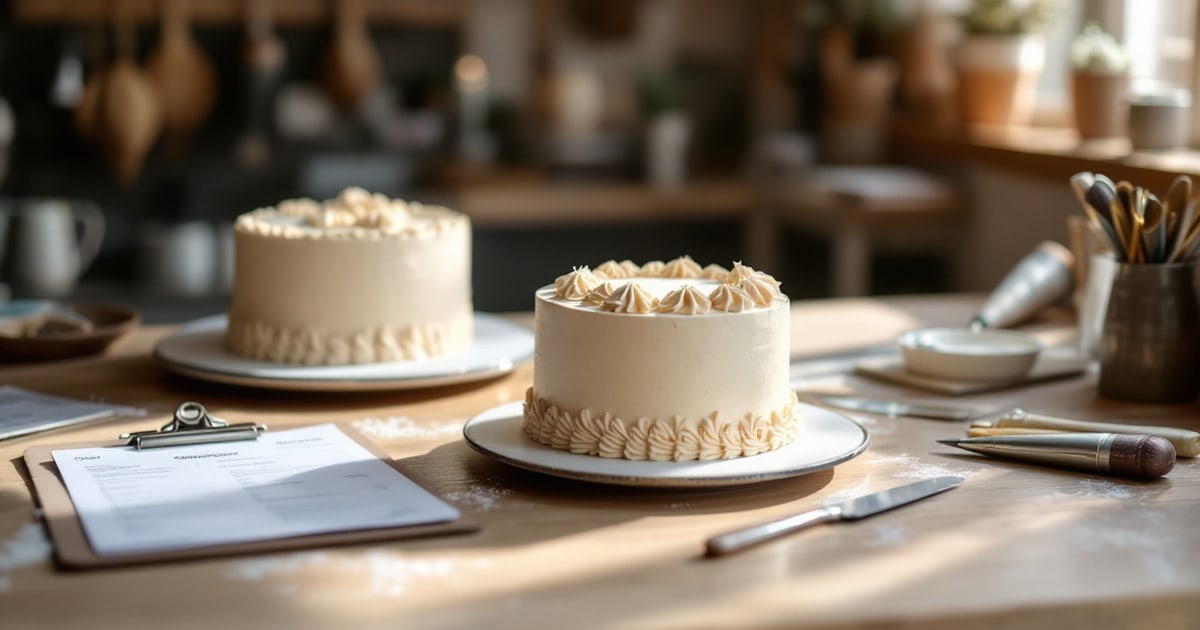
A donut shop plans one number per product per day. A cake shop plans two businesses at once: the custom orders already promised, and the case stock somebody might buy on the way home. Getting one right at the expense of the other is the most common way a cake shop loses money.
Custom work carries the margin. Case stock carries the walk-in trade and the impulse purchase. They compete for the same oven, the same bench and the same decorator, and they fail in opposite directions: too much case stock becomes waste, too little custom capacity becomes a turned-away order you never see again.
Start with committed capacity, not with what you hope to sell
Most planning advice starts from demand. For a cake shop it is more useful to start from what is already promised.
Before deciding anything on spec, lay out the week's confirmed orders by due date and work backwards through the stages each one needs — baking, filling, crumb coat, final decoration, and any curing or setting time between. What is left after that is your real spec capacity. Not what the oven could theoretically produce; what your decorator actually has hands free for.
Shops that skip this step tend to discover the conflict on Friday morning, which is the worst possible time to discover it.
Decoration time is the constraint, not oven time
Ovens are rarely the bottleneck in a cake shop. Decorators are. A sheet cake and a three-tier wedding cake might use similar oven time and wildly different bench time.
If you plan by units rather than by decoration hours, you will systematically over-commit. Two tiered orders and a dozen cupcakes is not "three orders", it is most of a day. Track roughly how long each product category takes at the bench, and plan against that number.
Set lead times you can actually hold
A lead time that gets broken every other week is not a lead time, it is a suggestion. Better to publish something you can hold and then occasionally beat it.
Sensible practice is to set different minimums by complexity — a simple round cake needs less notice than a tiered or sculpted one — and to close ordering earlier for the weeks you already know are heavy. Valentine's, Mother's Day and graduation season fill up faster than anything else in the calendar.
Deciding what to bake on spec
Case stock is the part that feels like guesswork, and it is where sales history earns its keep. The useful questions are narrow:
- Which sizes actually sell off the shelf, as opposed to which ones you like making?
- Which days carry walk-in traffic, and which are almost entirely pickup?
- What is the honest sell-through on each flavour before it has to be discounted or written off?
Once you have a few weeks of that written down, the pattern is usually obvious and often surprising. Shops frequently find that one flavour they have made every day for years is quietly subsidised by two others.
Slice economics deserve their own look
Selling whole cakes by the slice is the standard hedge against unsold stock, but it only works if the numbers hold. Compare the whole-cake price against slice price times realistic yield — not theoretical yield. Include the slices lost to cutting, the ones that do not sell by end of day, and the labour of portioning and boxing.
Sometimes it is clearly worth it. Sometimes it is a way of converting a $60 cake into $38 of revenue and calling it a save.
Seasonality is sharper than in other bakeries
Bread demand moves gently across the year. Cake demand does not. It spikes hard around a handful of predictable dates and sags in between, and the spikes are almost entirely custom rather than spec.
The planning implication is that your spec baking should usually go down in your busiest custom weeks, not up. Bench time is the scarce resource, and in those weeks it is already spoken for.
What to write down
Whatever system you use, these are the numbers that make next month's planning easier:
- Orders taken versus orders you had to decline, and why
- Decoration hours consumed per order type
- Spec production versus spec sold, by flavour and size
- Deposits taken and outstanding balances by due date
The declined orders matter most and get recorded least. They are the only direct evidence of demand you could have served with more capacity.
Where DoughOps fits
DoughOps handles cake shops as a first-class bakery type rather than treating everything as a donut. Custom orders carry due dates, decorator assignment, deposits and approval steps; production planning covers the spec side using weighted statistical analysis of your own sales history, adjusted for weather, holidays and local events. Both sit in the same place, so committed work and spec work are visible against the same day.
Recipe costing tracks live ingredient cost per cake, which is what makes the slice-versus-whole question answerable rather than a matter of opinion.
Common questions
How far ahead should a cake shop take custom orders?
It depends on complexity and your decorator capacity rather than a universal rule. Many shops set a shorter minimum for simple round cakes and a longer one for tiered or sculpted work, then close ordering earlier for known peak weeks. The important thing is publishing a lead time you can hold consistently.
How much should I bake on spec?
Start from your confirmed custom work and see what decoration capacity is genuinely left, then bake spec into that gap based on what has actually sold through on the same weekday. Spec production should usually fall during heavy custom weeks, because bench time is already committed.
Does production planning software work for cake shops, or is it only for high-volume bakeries?
It works, but the useful part is different. High-volume shops care most about per-product daily quantities. Cake shops get more value from seeing committed custom work and spec capacity against the same calendar, plus accurate cost per cake.
How do I handle deposits on custom cakes?
Take them at order time and record them against the order rather than as loose cash. DoughOps records deposits and outstanding balances on the custom order itself, so the balance due is visible at pickup without anyone checking a separate book.
Plan both sides of the cake business
DoughOps has a Free plan at $0 for a single baker, then Starter at $49, Pro at $99 and Business at $199 per month. The Free plan needs no card, and a 14-day trial unlocks every feature — when it ends your account moves to Free rather than being locked.
Start Free