
Ask any experienced donut shop owner what affects their daily sales most, and they'll tell you the same thing: weather.
Not marketing campaigns. Not menu changes. Not even day of the week. Weather is the single biggest external variable determining how many customers walk through your door—and yet most shops still make production decisions without systematically accounting for it.
A rainy Tuesday isn't just "slower than usual." It's typically 10-20% slower. A winter snowstorm doesn't randomly hurt sales—it can cut foot traffic by 15-35% depending on severity. These aren't vague patterns; they're measurable, repeatable impacts that should directly influence how many donuts you make.
The Weather-Traffic Connection: Real Numbers
Research across retail businesses shows clear correlations between weather conditions and foot traffic. For donut shops specifically—which rely heavily on impulse purchases and morning commuters—these effects are even more pronounced:
Breaking Down the Impact by Condition
Light Rain (0.1-0.3 inches/hour)
Most people still venture out, but impulse purchases drop. Your regular morning crowd shows up, but the "saw your sign and decided to stop" customers stay in their cars. Expect about 10% fewer transactions than a comparable dry day.
Heavy Rain (0.3+ inches/hour)
Now you're looking at a 20% drop or more. People postpone non-essential errands. Drive-through traffic holds up better than walk-in traffic. Your regulars still come, but everyone else waits for better weather.
Snow (Any Accumulation)
This is where things get interesting. Light snow (1-3 inches) reduces traffic by about 15%. But a significant snowstorm (6+ inches) can cut your usual volume by 35% or more. The first snow of the season often has a bigger impact than later storms as people adjust their behavior.
Extreme Heat (95°F+)
Counterintuitive but consistent: brutal heat keeps people indoors just like snow. Your morning rush might hold steady (people still need their coffee and donuts before work), but mid-morning and afternoon traffic drops noticeably.
Perfect Weather (65-75°F, Sunny)
This is your baseline. Not necessarily higher sales—just normal. Sometimes exceptional weather slightly boosts impulse purchases, but the effect is smaller than you'd think.
Why Manual Weather Checking Doesn't Work
Most shop owners check weather forecasts. They glance at their phone, see rain tomorrow, and think "better scale back a bit." The problem isn't awareness—it's execution.
Here's what actually happens:
- You check weather for tomorrow, but production planning requires a week-long view
- You remember rain reduces sales, but by how much? 10%? 25%? Which products are more affected?
- You adjust mentally, but that adjustment happens at 5 AM when you're tired and rushing
- You're conservative (making extra just in case), which defeats the purpose
- Next week, you forget exactly what you did and can't refine your approach
The result: weather awareness without weather fine-tuning. You know it matters, but you're not systematically using that knowledge to reduce waste.
DoughOps Weather Integration: Set It and Forget It
DoughOps automatically pulls 14-day weather forecasts from Open-Meteo, a professional meteorological API. Every morning, your production recommendations already account for predicted conditions.
Rain forecasted for Thursday? The system reduces Thursday's numbers before you even think about it. Snow expected Saturday? Your weekend order gets adjusted automatically. No manual weather checking required—it's baked into every recommendation.
Different Products React Differently
Here's something most shops miss: weather doesn't affect all products equally.
Raised donuts (glazed, filled, iced) tend to see the biggest drops in bad weather. These are impulse buys and grab-and-go items. When people aren't browsing, raised donut sales suffer first.
Cake donuts and coffee hold up better. Your regulars still want their morning routine regardless of weather. The coffee-and-cake-donut customer is more committed than the "I'll take a dozen glazed because they look good" customer.
Specialty items (fritters, croissants, seasonal offerings) often see disproportionate drops because they're purchased by browsers, not committed regulars.
Sophisticated weather-based planning accounts for these category differences. It's not just "make 20% less of everything"—it's smarter category-specific adjustments.
Ready to reduce waste and boost profits?
Book a DoughOps demo to see the workflow in your bakery.
Book a DemoThe Multi-Day Forecast Advantage
Single-day weather forecasts help with tomorrow's production. But 14-day forecasts unlock strategic planning:
- Ingredient ordering: Big storm predicted next week? Adjust your flour and sugar orders now
- Staffing: Three rainy days in a row? You might reduce hours for part-time staff
- Special promotions: Perfect weather Saturday? Plan a special batch of seasonal items
- Waste planning: Rough week ahead? Adjust baseline production to minimize end-of-day donations
This is where automated weather integration really shines. You're not just reacting to tomorrow—you're planning the whole week based on expected conditions.
Seasonal Weather Patterns Matter Too
Beyond daily forecasts, seasonal weather patterns should influence your baseline production:
Summer
Hot weather generally means slightly lower overall traffic. People vacation, routines change, and extreme heat keeps folks indoors. Your baseline should be 5-10% lower than spring/fall.
Winter
Cold weather can boost comfort food sales (donuts qualify!), but snow and ice create unpredictable disruptions. You need more flexibility in winter—tighter baseline production with ability to quickly adjust.
Spring/Fall
These are your stable seasons. Weather is more predictable, and traffic patterns are consistent. Use these periods to establish your true baselines.
Hurricane/Severe Weather Events
If you're in a region with hurricanes, tornados, or severe storms, these events create 48-hour disruptions that require dramatic production cuts. Having a system that automatically accounts for weather emergencies prevents massive waste.
Putting Weather Data into Action
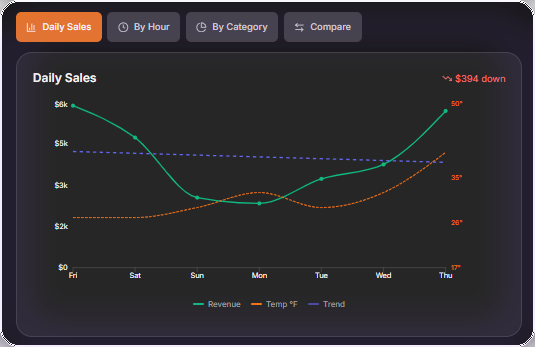
Sales dashboard with temperature overlay reveals the weather-revenue relationship
Knowing weather matters is one thing. Actually using that knowledge is another. Here's how modern shops are operationalizing weather data:
- Automated forecast integration: Weather data flows directly into production planning—no manual checking
- Historical correlation analysis: Systems learn how YOUR shop specifically responds to different conditions
- Category-specific adjustments: Different product categories get different weather multipliers
- Multi-day visibility: See the whole week's weather-adjusted plan at once
- Override capability: Bakers can still adjust if they disagree, but they start from an informed baseline
The Compound Effect
Here's the real power of weather-based production: the effects compound.
Saving 6 glazed donuts on one rainy Tuesday is nice but not transformative. Saving 6 donuts every rainy day, plus 12 on snowy days, plus 8 on extremely hot days, across a full year? Now you're talking about thousands of dollars in waste reduction.
A shop that systematically adjusts for weather might prevent:
- 40-50 rainy days per year (saving 5-10 donuts per day)
- 10-15 snow days (saving 10-20 donuts per day)
- 20-30 extreme heat days (saving 5-8 donuts per day)
That's 500-1,000+ donuts saved annually from weather fine-tuning alone. At $0.60-1.00 per donut in ingredient costs, you're looking at $300-1,000 in direct savings, plus saved labor and reduced donation processing time.
Getting Started with Weather-Based Planning
The good news: you don't need to become a meteorologist. Modern production planning tools handle the complexity for you.
DoughOps pulls forecast data automatically, applies your shop's historical weather response patterns, and delivers adjusted recommendations. You wake up to production numbers that already account for tomorrow's conditions.
The weather affects your business whether you plan for it or not. The question is whether you're going to let it create waste, or use it to make smarter decisions.
Ready to reduce waste and increase profits?
DoughOps helps shops adjust production before weather shifts turn into waste, missed sales, or last-minute scrambling. Start free today.
Start FreeRelated Articles
How to Plan Donut Production for Holidays (Without the Stress)
National Donut Day can see sales spikes of 50% or more. Learn how to plan for major holidays and seasonal events without the guesswork.

How Local Events Can Significantly Boost Your Donut Sales (If You're Prepared)
Music festivals, NFL games, and concerts can drive significant sales increases. Learn how to detect local events and adjust production.