
Sarah fell in love with your maple bacon bar on Tuesday morning. She raved about it to her coworkers, posted a photo on Instagram, and came back Thursday excited to get another one.
Except Thursday's maple bacon bar tasted different. The bacon wasn't as crispy. The maple icing was thinner. The donut itself seemed slightly denser.
Sarah didn't complain—she just never came back. And when her coworkers asked about your shop, she said "It's good, but kind of inconsistent."
That's how you lose repeat business. Not through catastrophic failures, but through subtle inconsistencies that erode trust. And the root cause is almost always unstandardized recipes.
Why Recipe Standardization Actually Matters
Many donut shop owners pride themselves on being artisans who bake "by feel." There's romance in the idea of a master baker who doesn't need measurements because they've made donuts for 20 years.
But here's the uncomfortable truth: customers don't care about your artisan process—they care about whether the donut tastes exactly like it did last time.
Consistent Quality Builds Customer Trust and Loyalty
Think about your favorite restaurant. You order the same dish every time because you know exactly what you're getting. That reliability is what brings you back.
Donut shops work the same way. When customers know they can count on your chocolate cake donut to taste perfect every single time, they become regulars. Consistency is the foundation of customer loyalty.
New Employees Can Replicate Recipes Exactly
Your head baker might know the raised donut recipe perfectly. But what happens when they're sick? Or take vacation? Or quit for a better opportunity?
Without documented, standardized recipes, every new baker brings their own interpretation. Proofing times vary. Icing ratios change. Temperature settings drift.
Standardized recipes mean anyone on your team can produce identical results, reducing your dependency on specific individuals.
Accurate Cost Calculations Per Product
How much does it actually cost to make a Boston cream donut? If your recipes are "eyeballed," you genuinely don't know.
Maybe your baker uses too much custard filling one day and too little the next. Maybe icing portions vary by 20%. These inconsistencies make accurate cost analysis impossible.
With standardized recipes, you know exactly how much of each ingredient goes into each product, enabling precise costing and pricing decisions.
Easier to Scale Production
Your recipe says "a handful of sprinkles." That works fine when you're making 2 dozen donuts. But what about 20 dozen for a catering order?
Standardized measurements let you scale production mathematically. If the recipe calls for 2 oz of sprinkles per dozen, you know you need 40 oz for a 20-dozen order. No guesswork.
The "Build Your Donut" Concept: Recipes as Components
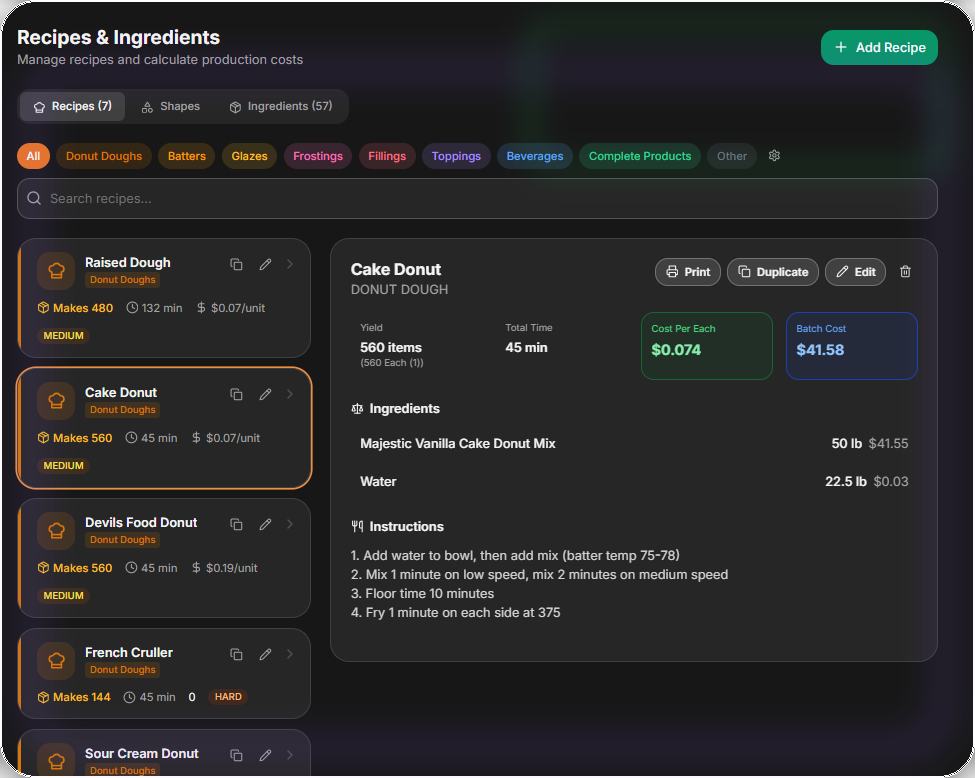
Recipe management with per-unit cost, batch cost, and step-by-step instructions
Here's where recipe standardization gets really powerful: treating donuts not as complete recipes, but as assemblies of standardized components.
Think of it like manufacturing. A car isn't built as a single unit—it's assembled from thousands of standardized parts. If the engine changes, you don't need to redesign the entire car. You just swap in a new engine.
Donuts work the same way. Every donut is an assembly of:
Shell (The Base)
- Raised yeast donut
- Cake donut (buttermilk, chocolate, old-fashioned)
- Specialty shells (croissant donut, fritter)
Filling (Optional)
- Bavarian cream
- Raspberry jam
- Lemon custard
- Boston cream (vanilla custard)
Icing
- Classic glaze
- Chocolate glaze
- Maple icing
- Strawberry icing
- Vanilla icing
Topping (Optional)
- Rainbow sprinkles
- Chocolate sprinkles
- Chopped bacon
- Toasted coconut
- Crushed Oreos
Example: A "Maple Bacon Bar" is composed of:
- 1x Raised Yeast Shell (Long John shape)
- 0x Filling (none)
- 1x Maple Icing (2 oz portion)
- 1x Bacon Topping (0.5 oz crumbled bacon)
This component-based approach has massive advantages:
1. Change Once, Update Everywhere
If you improve your maple icing recipe, every product using maple icing is instantly updated. You don't need to rewrite 8 different product recipes.
2. Easy to Launch New Products
Want to create a "Maple Bacon Cake Donut"? Just swap the shell component from "Raised" to "Cake." The icing and topping stay the same. You've created a new product in 30 seconds.
3. Accurate Ingredient Tracking
You know exactly how much maple icing is needed for tomorrow's production because the system adds up all products that use maple icing and multiplies by the standard portion size.
4. Consistent Portioning
Every maple bacon bar gets exactly 2 oz of icing and 0.5 oz of bacon. No more over-topping some and under-topping others.
How DoughOps Handles Recipe Management
DoughOps uses a component-based recipe system where you define shells, fillings, icings, and toppings once, then assemble products from these building blocks.
Each component has its own ingredient list and cost calculation. When you update a component recipe, all products using that component automatically reflect the change.
The system also links recipes to production planning, automatically calculating ingredient needs based on tomorrow's production quantities. No more manual math or guessing.
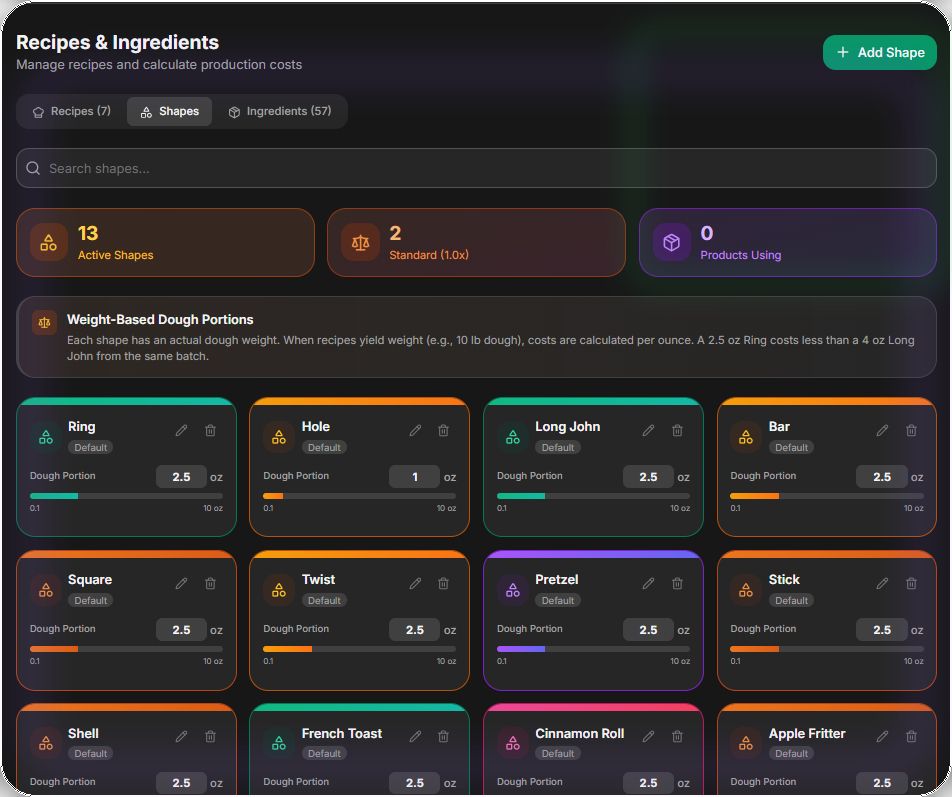
Standardized shapes with weight-based dough portions ensure consistent products every time
Ready to reduce waste and boost profits?
Book a DoughOps demo to see the workflow in your bakery.
Book a DemoDigital Recipe Management vs. Handwritten
Let's be honest: most donut shops still use handwritten recipe cards, binders, or worse—recipes that only exist in the owner's head.
Digital recipe management offers transformative advantages:
Automatic Cost Calculations
Enter ingredient prices once. The system automatically calculates the cost of each component and each finished product. When flour prices increase, you instantly see the impact on every product's food cost percentage.
Recipe Scaling
Your glaze recipe makes 5 quarts. But you need 12 quarts for a big production day. Digital systems instantly scale all ingredient quantities proportionally. No calculator required.
Version History
You tweaked the chocolate icing recipe last month. Now it's not as good as before, but you can't remember exactly what you changed.
Digital systems track every change. You can view previous versions and roll back if needed. It's like "undo" for your recipes.
Link Recipes to Products for Accurate Costing
When recipes are linked to products, changing an ingredient price automatically updates the cost of every affected product. You can instantly see which products are profitable and which aren't.
Multi-Location Consistency
If you have multiple locations, digital recipe management ensures every store makes products identically. No more "the donuts taste different at Location B" complaints.
Tips for Converting Existing Recipes to Standard Format
Convinced you need standardized recipes? Here's how to convert your existing informal recipes into proper standards:
1. Use Weight, Not Volume
A "cup" of flour can vary by 20% depending on how it's scooped. An ounce of flour is always an ounce.
Invest in a good digital scale and convert all measurements to weight. This single change dramatically improves consistency.
2. Document Every Step
Don't assume knowledge. Write out every detail:
- Exact temperatures (not "medium heat," but "350°F")
- Exact timing ("proof for 75 minutes at 85°F")
- Visual cues ("until dough pulls away from bowl sides")
- Portion sizes ("2 oz icing per donut using #16 scoop")
3. Test and Refine
Have someone who didn't write the recipe follow it exactly. Can they produce the same result? If not, the recipe needs more detail.
4. Photograph Finished Products
Include a reference photo showing what the finished product should look like. This gives employees a visual target for consistency.
5. Calculate Baker's Percentages
For doughs, use baker's percentages (all ingredients expressed as a percentage of total flour weight). This makes scaling recipes mathematically simple.
6. Standardize Portioning Tools
Use scoops, ladles, and portion scales to ensure identical serving sizes every time. Assign specific scoop sizes to specific components:
- Icing: #16 scoop (2 oz)
- Custard filling: #20 scoop (1.6 oz)
- Topping: 0.5 oz by weight
The Bottom Line on Recipe Standardization
Recipe standardization isn't about removing creativity or turning bakers into robots. It's about ensuring that when you create something amazing, you can replicate it perfectly every time.
Your customers don't want surprises. They want reliability. They want to know that when they order their favorite donut, it will taste exactly like it did last time—and the time before that, and the time before that.
That consistency is what builds loyalty, drives repeat business, and turns casual customers into regulars who come back every week.
The shops that standardize their recipes can expect benefits like lower ingredient costs (through portion control), faster employee training, higher quality consistency, and better profitability through accurate costing.
The shops that don't? They keep wondering why customers don't come back as often as they should.
Which shop do you want to be?
Ready to reduce waste and increase profits?
DoughOps helps donut shops standardize recipes, tighten daily planning, and reduce the expensive inconsistency that shows up in waste, labor, and repeat visits. Start free today.
Start FreeRelated Articles

The Hidden Cost of Donut Waste: What Every Shop Owner Should Know
Most shops underestimate how much waste really costs. We break down the true impact and show you how to fix it.

Daily Checklists That Keep Your Donut Shop Running Smoothly
From opening prep to closing cleanup, structured checklists ensure nothing falls through the cracks.