
Your donuts are only as good as the team making them. Perfect recipes and expensive equipment mean nothing if the person working the fryer at 3 AM doesn't know what they're doing—or doesn't show up at all.
But managing a donut shop team comes with challenges most businesses never face: shifts that start at 2 AM, physical demands that burn people out, and the reality that industry estimates suggest food service has roughly a 75% annual turnover rate. You're constantly training new people while trying to maintain consistency and quality.
The shops that thrive despite these challenges don't rely on luck or heroic individuals. They build systems that work regardless of who's wearing the apron. Clear roles, structured training, and smart accountability turn temporary staff into reliable teams.
The Donut Shop Staffing Challenge
Before talking about solutions, let's acknowledge the unique difficulties of donut shop staffing:
Early Hours Make Hiring Difficult
A 2-4 AM start time eliminates most of the labor pool. People with kids, anyone relying on public transportation, and those working second jobs often can't commit to bakery hours. You're fishing from a much smaller pond than a restaurant with normal shifts.
High Turnover Is Industry Reality
Industry estimates put food service turnover around 75% annually. Donut shops may exceed that due to early hours and physical demands. You're not failing if people leave—you're fighting structural headwinds. The question is how to minimize turnover and maintain quality despite it.
Varying Skill Levels
Your team might include a 20-year veteran baker, a culinary school graduate, and a high school student who's never worked food service. Somehow, they all need to produce consistent results.
Part-Time vs. Full-Time Mix
Most donut shops can't afford all full-time staff, so you're juggling schedules with part-timers who have availability constraints and competing priorities. Knowledge transfer becomes critical when no one person is always there.
Clear Role Definitions Matter (More Than You Think)
When everyone does "a little bit of everything," nothing is anyone's responsibility. When tasks are clearly assigned, accountability becomes possible.
Owner: Strategy, Finances, and Big Picture
Responsibilities:
- Financial planning, pricing, and profitability analysis
- Long-term strategy (menu changes, expansion, equipment purchases)
- Vendor relationships and major purchasing decisions
- Marketing strategy and community presence
- Hiring managers and setting compensation
NOT responsibilities: Daily production decisions, shift coverage, routine troubleshooting. If you're the owner and you're still deciding how many glazed donuts to make every single morning, you're stuck in operator mode instead of owner mode.
Manager: Daily Operations, Scheduling, and Quality Control
Responsibilities:
- Daily production planning and approvals
- Staff scheduling and shift coverage
- Quality control and recipe adherence
- Training new staff and evaluating performance
- Inventory management and ordering
- Customer complaint resolution
- Opening and closing procedures
Authority: Managers need permission to make decisions without owner approval. If they have to call you about every little thing, they're not really managing—they're just doing your administrative work for you.
Baker: Production, Tasks, and Front of House
Responsibilities:
- Following approved production plans
- Executing recipes consistently
- Completing daily task checklists (cleaning, prep, stock rotation)
- Front-of-house service when needed
- Logging waste and reporting issues
- Suggesting improvements based on frontline experience
Authority: Bakers should have clear guidelines for when they can make judgment calls (adjusting a batch that's not proofing correctly) vs. when they need manager approval (changing production quantities).
DoughOps Role-Based Access Control
DoughOps has three permission levels built-in: OWNER, MANAGER, and BAKER. Owners manage billing and team settings. Managers approve production plans, view reports, and manage tasks. Bakers log waste, complete checklists, and boost production—without accessing financial data or changing settings they shouldn't.
This isn't just about security—it's about clarity. When the software enforces role boundaries, everyone knows exactly what they're responsible for.
Ready to reduce waste and boost profits?
Book a DoughOps demo to see the workflow in your bakery.
Book a DemoTraining That Actually Sticks
Most donut shop training looks like this: "Shadow Sarah for a week." The new hire follows someone around, picks up bits and pieces, and starts working independently when Sarah says they're "probably ready."
This approach has problems:
- Sarah might be great at baking but terrible at explaining
- No two people learn the same things (the next new hire gets different training)
- There's no way to verify what the new hire actually knows
- Important but infrequent tasks get missed (what happens during a power outage?)
Structured training is better training:
1. Standardized Onboarding Checklists
Create a literal checklist of everything a new hire needs to learn, organized by priority:
Day 1-3 (Must-know basics):
- Safety procedures (fryer safety, burn protocol, emergency exits)
- Clocking in/out and break procedures
- Hand washing and food safety basics
- How to answer the phone and greet customers
- Where things are located
Week 1 (Core production skills):
- Reading and following production plans
- Basic donut frying (cutting, proofing, frying)
- Icing and topping application
- Quality standards (what's sellable vs. waste)
- Front counter basics (register, packing donuts)
Week 2 (Independence and troubleshooting):
- Working alone during slow periods
- Handling common problems (dough too sticky, icing too thick)
- Completing opening or closing checklists
- Logging waste and donation records
2. Standard Operating Procedures (SOPs) for Every Task
Write down your processes. Not in paragraph form—in step-by-step instructions with pictures:
- "Opening Checklist: 15 Steps Every Morning"
- "How to Make Glazed Raised Donuts: 12 Steps with Photos"
- "Closing the Shop: 20-Minute Checklist"
- "What to Do When the Fryer Won't Heat Up"
These documents serve two purposes: training new staff and providing quick reference for everyone. Even experienced bakers forget steps occasionally.
3. Visual Guides and Recipe Cards
Laminated recipe cards at each workstation eliminate guesswork. No one needs to remember icing ratios or proofing times—it's right there. Photos of correctly proofed dough, properly iced donuts, and finished products set quality standards without subjective judgment calls.
4. Progressive Responsibility
Don't throw new hires into the deep end. Start them on simple, low-risk tasks and gradually increase complexity:
- Week 1: Topping and decorating (hard to mess up badly)
- Week 2: Frying under supervision (can create waste if done wrong)
- Week 3: Dough preparation and proofing (requires timing and judgment)
- Week 4+: Independent shifts and troubleshooting
Accountability Without Micromanaging
You can't watch every shift personally. You shouldn't have to. The goal is building accountability into your operations so you can trust your team without hovering.
Digital Task Checklists with Timestamps
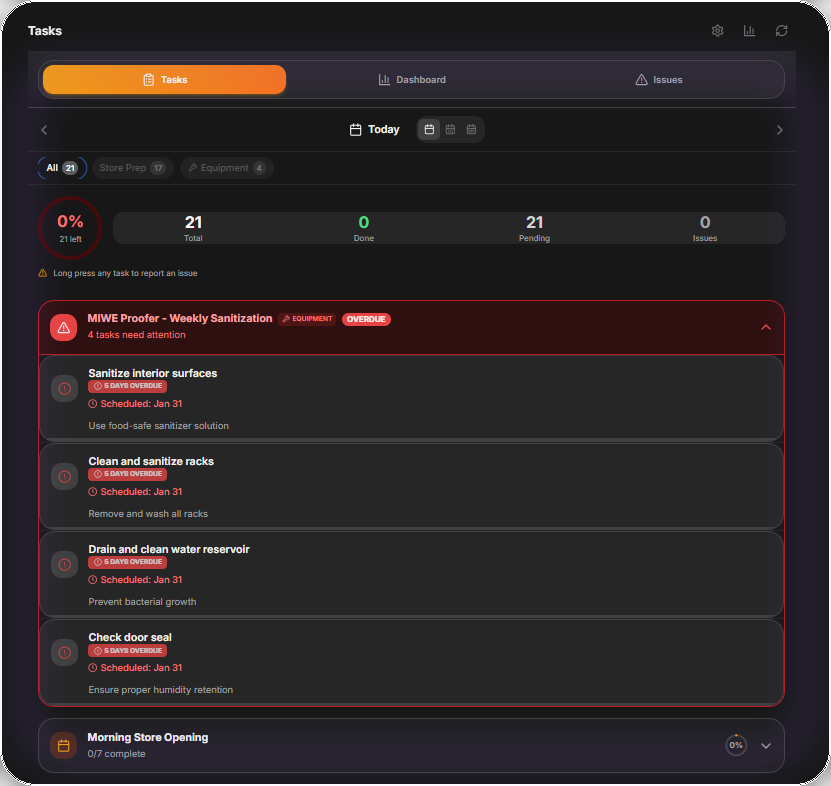
Digital checklists with timestamps, overdue tracking, and completion stats
Paper checklists are easy to fake. Someone can check every box at once without actually doing the tasks. Digital checklists with timestamps show when each task was actually completed, creating real accountability without accusation.
If cleaning the fryer is supposed to happen at 2 PM but the log shows it was checked off at 2:47 PM, you have visibility. If someone consistently completes tasks late, you can address it specifically rather than having a vague sense that "things aren't getting done."
Gamification: Make Accountability Rewarding
People respond to progress tracking and recognition:
- Completion streaks: "7 days of perfect opening checklists!"
- Team achievements: "This week: 95% task completion rate—best ever!"
- Individual stats: Friendly leaderboards for tasks completed, waste reduction contributions
This isn't childish—it's psychology. Recognition drives behavior, especially for younger staff who grew up with progress bars and achievement badges.
Exception Reporting: Document Issues, Not Blame
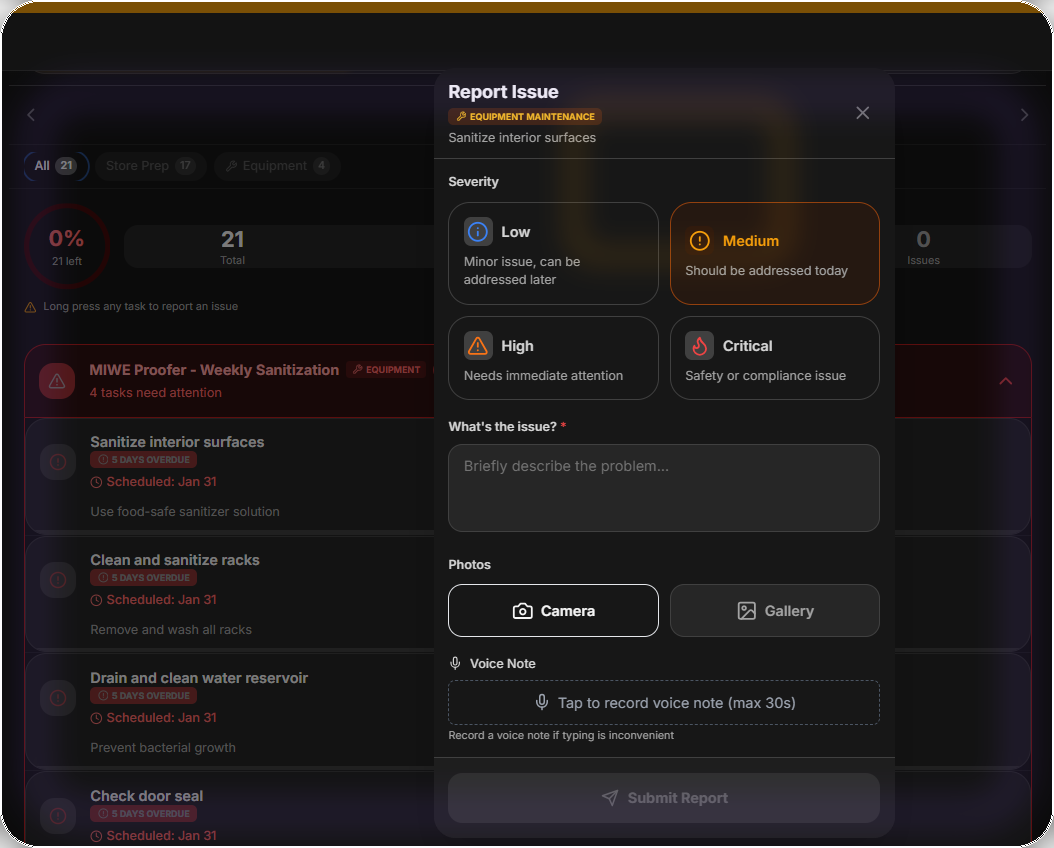
Staff can report issues with photos, severity levels, and voice notes
Sometimes tasks can't be completed on time for legitimate reasons. Rather than skip the task and say nothing, staff should log exceptions: "Couldn't clean fryer at 2 PM because we had a 10-box rush order. Completed at 3:15 PM after rush ended."
This documentation protects staff (they're not being negligent) while giving managers visibility into operational bottlenecks. If exceptions happen repeatedly, it's a staffing or process problem, not a person problem.
Manager Dashboards for Oversight
Managers need visibility without micromanaging. Dashboards that show:
- Today's task completion rate
- Which tasks are overdue or skipped
- Exception reports requiring review
- Team performance trends over time
This lets managers manage by exception. Instead of checking on everything constantly, they review dashboards once or twice a day and address only items that need attention.
DoughOps Task Management for Bakers
DoughOps includes digital task checklists that bakers complete on their phones or tablets. Tasks are assigned by role (BAKER sees their tasks, MANAGER sees oversight), completion is timestamped automatically, and exceptions are logged with reasons.
Managers get daily summary emails and dashboard views showing completion rates, streaks, and trends. It's accountability without clipboard-checking or suspicion—just transparency for everyone.
Building Team Culture in a High-Turnover Industry
You can't eliminate turnover, but you can create a culture that retains your best people and makes new people want to stay:
Respect the Early Hours
Don't act like 2 AM shifts are normal. Acknowledge that they're tough. Offer shift premiums for overnight work. Let people leave as soon as their work is done instead of forcing clock-watching until scheduled end times. Small gestures of respect build loyalty.
Invest in Training
Employees stay when they feel they're learning and growing. Investing time in proper training signals that you value them. Cross-training people on multiple positions makes work more interesting and makes them more valuable to you.
Recognize Good Work
Most bakery work is thankless. A customer might say "nice donuts" but they don't know who made them. Public recognition in team meetings, shout-outs in group chats, or bonuses for perfect weeks make people feel seen.
Give People a Path Forward
If every baker sees a dead-end job with no advancement, they'll leave as soon as something better comes along. Create paths: Baker → Lead Baker → Assistant Manager → Manager. Even if advancement is slow, knowing it's possible keeps people engaged.
Technology as Team Multiplier
Modern tools can't replace good management, but they make good management scalable. Role-based access, digital checklists, automated reporting, and visibility dashboards let one manager effectively oversee what used to require constant presence.
This doesn't eliminate the human element—it preserves it. Instead of spending time on administrative tracking, managers can focus on coaching, training, and building relationships. Instead of second-guessing production numbers every morning, bakers can focus on execution and quality.
The goal isn't to automate people away. It's to automate the tedious parts so people can focus on what actually requires human judgment, skill, and care.
Putting It All Together
Building a reliable donut shop team in a high-turnover industry requires:
- Clear roles so everyone knows what they're responsible for
- Structured training that works regardless of who's doing the training
- Smart accountability that creates visibility without micromanaging
- Respectful culture that values early-morning warriors doing hard work
- Technology support that makes management scalable
You'll still have turnover. You'll still have tough days. But you'll have systems that work despite these challenges, not in spite of them.
The donut shop that runs smoothly whether the owner is there or not—that's the one built to last.
Build a team that runs itself
DoughOps gives donut shops clearer accountability, digital checklists, and shared daily visibility so managers spend less time chasing execution gaps. Start free today.
Start FreeRelated Articles
Daily Checklists That Keep Your Donut Shop Running Smoothly
From opening prep to closing cleanup, structured checklists ensure nothing falls through the cracks.

Managing Multiple Donut Shop Locations: What Changes When You Scale
Opening a second shop is exciting, but managing two (or more) locations requires completely different systems. Learn what breaks when you scale.